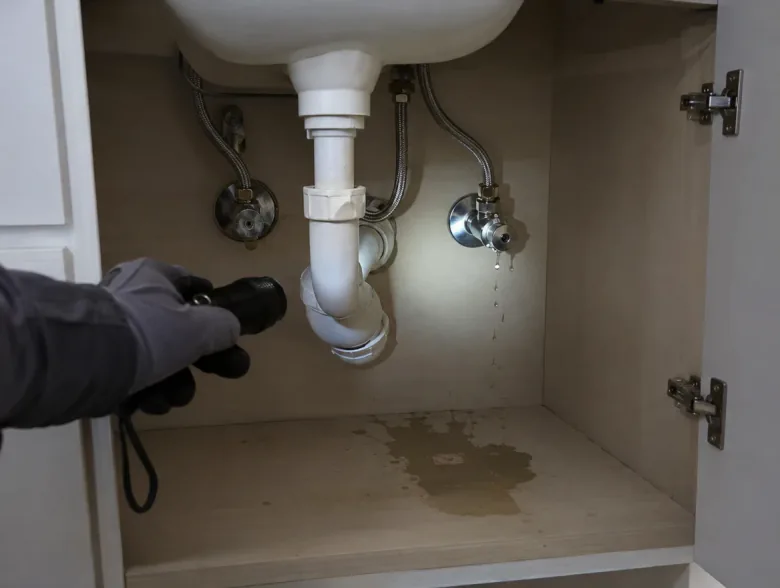
Bathroom leak detection in Government Departments Complex 2nd District
Bathroom leak detection in Government Departments Complex 2nd District uses specialized instruments to locate water's source without breaking walls or tiles. The damp stain on the ceiling may be far from where the leak actually starts.
From your call to finding the source
- 1
Describe what you see
Call or message us on WhatsApp and tell us where the damp or stain appears, and whether you notice it after using the bathroom or at all times.
- 2
We inspect with instruments
We pass detection instruments over the bathroom floor, walls, supply lines and drain connections, without breaking any surface.
- 3
We pinpoint the source
We distinguish a supply line leak from a drain leak or a failure in the waterproofing under the tiles, because each source needs a different repair.
- 4
You receive a certified report
We give you a certified report after inspection naming the exact location of the bathroom leak and its cause, so you know precisely what needs to be repaired.
Relax, the source can be found
- We check the bathroom with instruments without breaking the tiles
- We tell a supply leak apart from a drain leak
- We find a leak under the tiles without lifting them
- Certified report after inspection stating the source and cause
- We take your request by phone call or WhatsApp message
The service in Government Departments Complex 2nd District
In a residential complex like this district, each bathroom has heating pipes, drainage lines and complex plumbing connections. Water may leak from a heater, air conditioning line or a hidden joint in a wall or under the floor. A damp stain in the bathroom ceiling or an adjacent room may result from pipes running in the layer above or below. The technician traces pipe routes and tests pressure in each line to pinpoint the problem precisely before opening anything.
Government Departments Complex 2nd District is a district in Al-Ahsa governorate in the Eastern Province, close to Al Hamra 1st District, Al Aziziyah 1st District and Al Hamra 2nd District.
Water leaking from the bathroom heater or hot water connection is the most common cause of damp under the bathroom.
Our portfolio















What our customers say
- ★★★★★
شغلهم كويس وناس ممتازه في اسرع وقت
- ★★★★★
شغلهم نظيف وسريعين ومحترمين الله يعطيهم العافيه
- ★★★★★
شكرا على التواصل السريع
Reviews are shown as the customers wrote them, in Arabic.
Questions about Bathroom leak detection in Government Departments Complex 2nd District
A supply line leak shows at any time because the pressure is constant, while a drain leak usually shows during or just after use. Even so, water travels under the tiles and shows away from the source, so the position of the stain alone is not enough to tell the type.
It may be, especially if the household size and habits have not changed. A supply line leak under the floor or behind the wall does not show to the eye but raises the bill gradually. Instrument inspection finds what does not appear on the surface.
Because water runs across the slab to the lowest point before it drips. It can travel a distance away from the real source, so the stain appears where you do not expect it. That is why instrument inspection traces the water's path and not just the stain's position.
Yes, the waterproofing under bathroom tiles is exposed to warm water, cleaning products and repeated heat, so cracks can form in it or its joints with the walls and drains can open. Water then seeps under the tiles slowly without being visible on the surface.
Yes, a persistent musty smell usually points to hidden damp in the wall or under the tiles, especially if it does not clear with ventilation. A slow leak may continue for weeks before a visible stain appears, and early inspection reduces what needs repair later.
A tray leak means the tray itself, its edges or its joint with the wall allows water through, and damp usually shows on the next wall. A drain connection leak means water exits where the tray meets the drain pipe, and it usually collects directly under the floor.
Tell us where the sign appears, whether a stain on the ceiling, damp on the wall or water on the floor, and whether it shows only after use or all the time, and whether you have noticed the water bill rising. The more precisely you describe what you see in the bathroom, the more directly we can aim the inspection at the likely source.
Clean water comes from heating, cooling and cold water lines; wastewater comes from bathroom drains, toilets and traps. Pressure testing and pipe tracing distinguish between them, and smell and appearance help too.
Tell them the stain's size and shape, whether it is directly under the vanity or away from it, if the ceiling is slightly damp or very wet, and whether the moisture comes from above, from the wall or from directly under you.
More services in Government Departments Complex 2nd District
Bathroom leak detection in nearby areas
