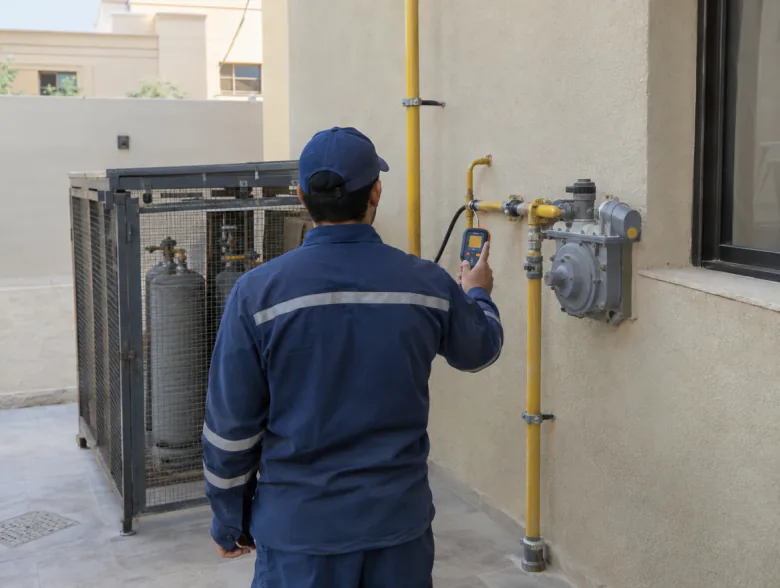
What central gas network inspection includes
- Checking the main meter, the regulator and their connecting joints
- Following the gas line from the meter through the building walls with detection instruments
- Checking the joints between pipes at every branch point in the network
- Checking the isolation valves at each unit and outlet in the building
- Checking the gas connection joints at every cooker or appliance fed by the network
- Identifying the leak's location and likely cause in the network and telling the client where it is
From your call to the location
- 1
Tell us what you notice
Call or message us on WhatsApp and tell us about the network in your building and where you notice the smell or the pressure change.
- 2
We check from meter to kitchen
We start at the meter or main regulator, and follow the line through walls and ceilings to the connections at each unit.
- 3
We check joints and valves
The joints between pipes, the valves and the gas outlets at each cooker are checked with detection instruments one by one.
- 4
We pinpoint the leak
After the check we tell you where in the network the leak is and its likely cause, so you know which part needs attention.
The network needs a full check, not a partial one
- We check the network from the meter to the last outlet
- We follow pipes inside walls with instruments
- We check every joint, valve and regulator in the line
- We find the leak without breaking the walls
- We take your request by phone call or WhatsApp message
The service in Al Badriyah District
Buildings in Al Badriyah District, like others in the area, depend on a central gas network linking main shut-offs to appliances in each unit. Leaks occur in underground pipes, joints inside walls, or at distribution valves. The first check looks at overall pressure, smell and visible areas, then the technician moves to hidden lines using precise detection instruments. Each network section is tested separately until the actual leak location is found.
Al Badriyah District is a district in Al-Ahsa governorate in the Eastern Province, close to Imam Muhammed Ibn Saud Islamic University District, Al Majidiyah District and Al Quds District.
Detection instruments find leaks before the smell becomes strong or pressure becomes dangerous.
Our portfolio















What our customers say
- ★★★★★
شكرا على التواصل السريع
- ★★★★★
شركة ممتازة تستحق التعامل معها بشكل مستمر
- ★★★★★
شكراً لخدمتك الجميلة
Reviews are shown as the customers wrote them, in Arabic.
Questions about Central gas leak detection in Al Badriyah District
A single cylinder has a short hose and one or two connections that are easy to inspect visually or with foam. A central network has a long line running inside walls, with joints, valves and a main regulator. That length means detection instruments are needed to follow the gas along the whole route, not just at one point.
A central network branches from a main line to individual feeds. Weak pressure in one unit but not others usually points to a leak or a partial blockage in the branch feeding that unit, not in the main line. Checking starts by isolating each branch to find where the problem is.
Not necessarily, but they are harder to detect because the gas seeps slowly behind the plaster and does not reach the air in enough concentration to smell clearly. Instruments measure gas concentration through materials and can find this type of leak that produces no obvious smell in the room.
Yes. A regulator is a mechanical part whose seals wear over time, and it is a common source of leaks in older central networks. This is why the regulator is checked as part of the full network inspection, not after it, because replacing a pipe without checking the regulator may leave the source of the leak in place.
Tell us whether the building is a villa or has multiple units, where you notice the smell or pressure change, and whether the problem is in one unit or more. If you know where the main meter or tank is, mention it, as that helps us decide where to start.
Checking with instruments is done without cutting supply or shutting off appliances. The technician traces the entire network while it operates normally.
Say where you first noticed the smell or pressure drop, whether the problem is recent or long-standing, and whether all appliances are affected or only some. If you can, say how many units or floors the network serves.
Central gas leak detection in nearby areas
