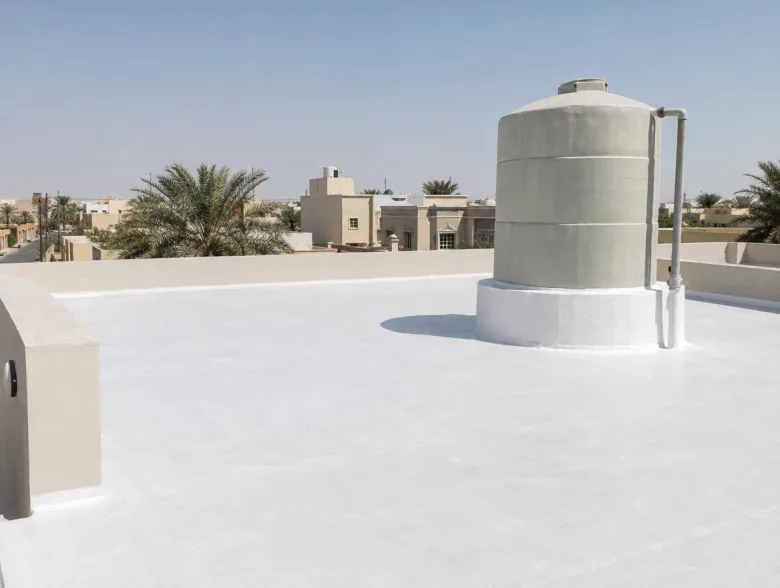
What this service includes
- Checking the roof slab, joints, drains and parapet before starting
- Treating cracks, edges and joints in the roof before the waterproofing is applied
- Waterproofing the full roof area including the zone around the tank base
- Waterproofing the tank base and outer walls on top of the finished roof
- Adding thermal insulation with polyurethane foam on the roof where needed
- Treating the shared weak points between the tank and the roof in a single job
From your call to the finished job
- 1
Describe what you see
Call or message us on WhatsApp and tell us whether the damp shows on the roof, below it, around the tank, or in all of these places.
- 2
We inspect the roof and the tank together
We check the condition of the roof slab, the joints, the edges and the parapet, then the tank base and its outer walls, because each affects the other.
- 3
We waterproof the roof first
The roof slab is prepared and the cracks, joints and drains are treated, then the waterproofing layer is applied across the full area including the zone around the tank base.
- 4
We treat the tank on a finished roof
Once the roof is ready we waterproof the tank base and its outer walls, so both layers work together and neither undoes what the other seals.
One treatment instead of two
- The tank and the roof are treated together in one complete job
- The order of the work stops one waterproofing layer from damaging the other
- We waterproof and thermally insulate according to each surface's condition
- We take your request by phone call or WhatsApp message
- Cost depends on the case, message us to work it out together
The service in Al Salmaniyah Forth District
In a district like Al Salmaniyah Forth, a water tank often sits on the roof, with drains around it, and the roof itself needs protection from heat and water. If the tank leaks, water runs on the roof and enters joints and cracks, dampening the top ceiling. Treating the tank alone does not solve the problem, because the roof is now damp. The team checks the tank base, joints, steps and parapet, cleans and dries the roof, then seals everything with foam, bitumen and epoxy.
Al Salmaniyah Forth District is a district in Al-Ahsa governorate in the Eastern Province, close to Ar Rabwah District, Al Salmaniyah Second District and Al Salmaniyah Third District.
The joint between the tank base and roof, and the joint between the parapet and roof, are where water gathers and leaks most.
Our portfolio















What our customers say
- ★★★★★
شركه ممتازه واشتغلنا معاهم اكثر من مره وجود عاليه ما شاء الله بارك الله فيهم واعمله
- ★★★★★
شركه ممتاز شغلهم كويس ويعطيهم العافيه
- ★★★★★
شركه ممتازه
Reviews are shown as the customers wrote them, in Arabic.
Questions about Tanks & roofs together in Al Salmaniyah Forth District
Yes, if the roof slab is sound and the joints and drains are tight, treating the tank alone is enough. But if the roof has cracks or signs of damp, ignoring it means water will find a way through even after the tank is sealed. That is why we check both before deciding.
They suit the roof's condition and what it needs. Bitumen rolls are laid over open areas and the edges and joints are sealed. Epoxy suits the finish around the tank base and at the drains. Polyurethane foam may be added for thermal insulation where the roof is exposed to direct sun.
The tank base sits directly on the roof slab, and any water that leaks from under the tank stops only where the waterproofing ends. If the slab is bare or has an old worn layer, the water soaks into it and reaches the floor below. Over time the slab itself cracks under the accumulated moisture.
If the stain is concentrated directly below the tank, the tank is likely the cause. If it spreads across a wider area of the ceiling, the roof is the more likely source. But the two often work together to bring water to the same place, so inspection alone tells them apart with certainty.
Tell us whether the damp appears on the top-floor ceiling, on the roof surface around the tank, or both. Tell us whether the tank is concrete or fibreglass and whether water appears under its base. These details tell us where to start and which materials suit the situation.
The team checks the tank type and material, and the roof for cracks, damp and joints, then chooses foam for heat insulation and bitumen or epoxy for water sealing, depending on what each area needs.
Yes, cracks in the roof and joints around the parapet and drains let water in, especially when rain falls. The team checks the roof first and determines if the leak is from the tank, the roof or both.
More services in Al Salmaniyah Forth District
Tanks & roofs together in nearby areas
