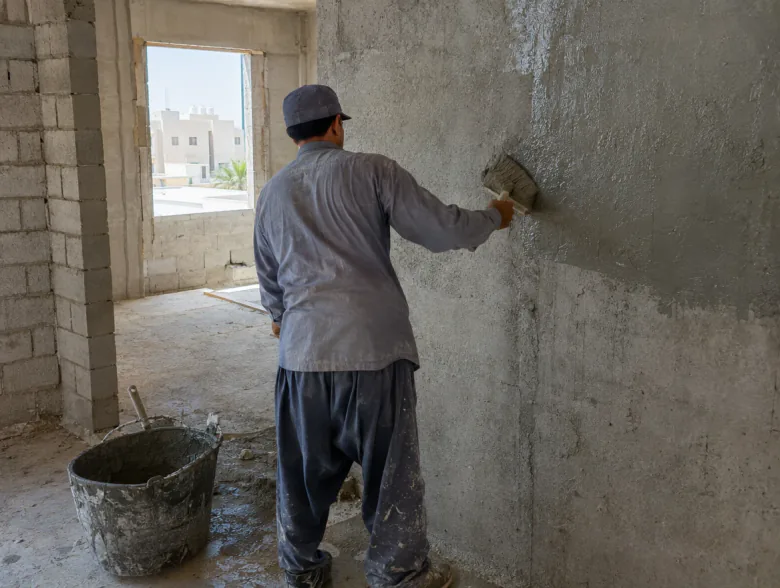
What cementitious waterproofing includes
- Assessing the concrete surface and the state of any existing coating before starting
- Removing loose sections and cleaning the surface in preparation for application
- Treating surface cracks in the concrete before the slurry goes on
- Mixing the cementitious material and applying it to walls, floors or the tank
- Extra care at joints and corners as these are the most common entry points for water
- Checking the surface after application to confirm coverage of critical areas
From your call to the finished coat
- 1
Describe what you see
Call or message us on WhatsApp and tell us where the damp is: a wall, a tank, a wet room or elsewhere, and what you notice on the surface.
- 2
Preparing the surface
The job starts with cleaning the concrete, removing loose sections and surface cracks so the slurry bonds to a solid base.
- 3
Mixing and applying the slurry
The powder is mixed with water to an even consistency, then brushed or sprayed onto the surface so it penetrates into the pores.
- 4
Treating joints and corners
The joints between the wall and the floor and the corners of a tank are where water usually enters first, so they receive extra attention during application.
Why it suits these surfaces and tanks
- Penetrates concrete pores and bonds to them
- Safe for use in water tanks
- Suits walls, wet rooms and concrete surfaces
- Handles water pressure from inside and outside
- We take your request by phone call or WhatsApp message
The service in King Faisal University 3rd
In a district like King Faisal University 3rd, lower walls and foundations often suffer seepage of salty groundwater because Al-Ahsa soil is deep with saline water. The leak shows as wet stains and salt bloom on the wall, and it may weaken the foundation and joints between concrete sections. The team begins with a thorough inspection of the wall and foundation to find where and how deep the leak is, then cleans the surface of salt and weak layers, prepares it with care, and finally applies cementitious coat to fill the pores and keep water out.
King Faisal University 3rd is a district in Al-Ahsa governorate in the Eastern Province, close to Hajr District, Sports City and Mansubi Al Taleem 1st District.
The first inspection checks how deep the leak has penetrated the wall and foundation, because salty water may have reached deep layers of the concrete.
Our portfolio















What our customers say
- ★★★★★
شركه ممتازه واشتغلنا معاهم اكثر من مره وجود عاليه ما شاء الله بارك الله فيهم واعمله
- ★★★★★
شركه ممتازه
- ★★★★★
ممتاز والخدمة ان شاء الله تكون قد التوقعات
Reviews are shown as the customers wrote them, in Arabic.
Questions about Cementitious waterproofing in King Faisal University 3rd
It goes on concrete, cement render, brick and block. It works well on stable surfaces that do not move or flex, such as tank walls, wet room floors and flat concrete roofs. It does not suit surfaces subject to ongoing movement or wide expansion joints.
Cementitious coating penetrates and bonds inside the concrete pores rather than forming a separate sheet on top. Bitumen rolls and plastic membranes form a separate layer above the surface. So the cementitious option is chosen when the surface is stable concrete with no expected movement.
Yes, it is used in water tanks because the cementitious material is naturally compatible with concrete and does not release harmful substances after it cures. However, any loose old coating must be removed and the surface cleaned well before application so the slurry bonds directly to sound concrete.
The floor and wall meet at a joint that is usually the first weak point. Water collects at that joint, enters the concrete and then rises by capillary action. That is why corners and joints receive special attention when cementitious waterproofing is applied in wet rooms.
Tell us where the damp is: a bathroom, a tank or an internal wall. Tell us whether it appears after use or all the time, and whether there is peeling paint or salt deposits on the surface. The clearer your description, the easier it is for us to assess the surface condition before we visit.
Early stains are not serious if treated early, but they may spread and weaken the wall and foundation if left. Cementitious coating stops the leak and prevents it spreading further.
Say exactly where the stains are, whether they start at floor level or higher up, how far they spread on the wall, whether the wall is inside or outside the house, and send a recent photo of the stains and salt on WhatsApp.
More services in King Faisal University 3rd
Cementitious waterproofing in nearby areas
