What bitumen roof waterproofing includes
- Checking the roof surface and identifying points that need extra preparation before the rolls go down
- Cleaning the surface and removing failing layers and dirt that would weaken the bond
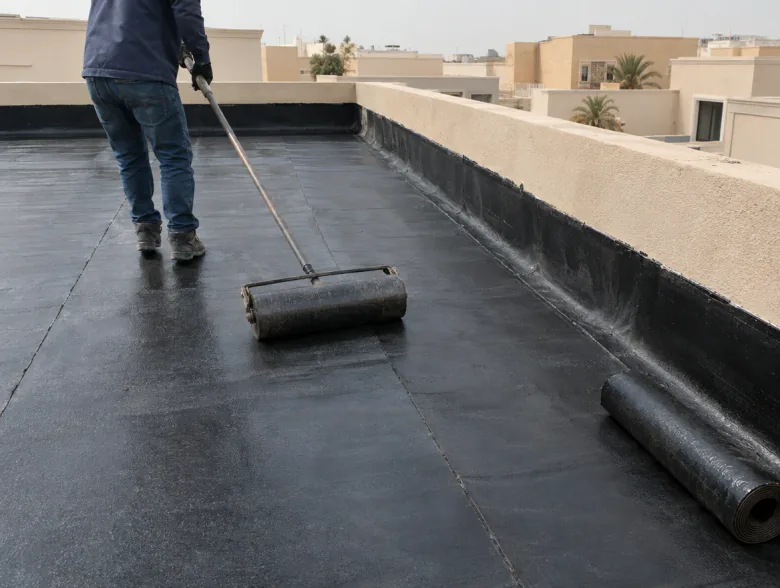
- Laying bitumen rolls with enough overlap at every seam between one strip and the next
- Sealing the roll edges at the parapet on both the horizontal and vertical faces
- Treating the specific points around drain bases, pipes and AC unit stands
- Confirming the layer is continuous with no break from the centre to every edge
From your call to the sealed roof
- 1
Describe what you see
Call or message us on WhatsApp and tell us what shows on your ceiling or roof surface. We will guide you to the next step.
- 2
Preparing the surface first
The job starts by cleaning the surface of dirt and failing layers, because a roll only bonds well to a clean, sound base.
- 3
Laying and overlapping the rolls
The rolls are laid in parallel strips and each strip overlaps the next at the edge, because the seam between two strips is the most vulnerable point in any bitumen covering.
- 4
Sealing the edges and penetrations
The membrane edges are sealed at the parapet and around every drain base, pipe and AC stand, because these specific points are where water most often enters.
Bitumen rolls suit your roof
- We take your request by phone call or WhatsApp message
- Seams are sealed, not left open
- Parapet edges and drain bases receive particular care
- The surface is prepared before the rolls go down
- The rolls are laid in overlapping strips
The service in ’Uray’irah
In a village like 'Uray'irah, homes usually have flat roofs and may have a tank, parapet or drain on the roof. Dampness and salt from groundwater affect lower walls, and water from rare rains looks for cracks and upper joints. Bitumen is laid on the roof in an overlapping pattern so each roll covers part of the next, and every joint is done with care. Before laying, the surface is checked for cracks, damp and dirt, because an unclean surface stops bitumen from gripping properly.
'Uray'irah is a village in Al-Ahsa governorate in the Eastern Province, close to Umm Tali, Umm Rubay'ah and Umm al Hamam.
The first inspection looks for damp under the old layer, because its presence weakens the new bitumen.
Our portfolio















What our customers say
- ★★★★★
شغلهم ميه ميه يشكرو عليه
- ★★★★★
شكرا على التواصل السريع
- ★★★★★
شركه ممتاز شغلهم كويس ويعطيهم العافيه
Reviews are shown as the customers wrote them, in Arabic.
Questions about Bitumen roof waterproofing in ’Uray’irah
Bitumen rolls suit flat concrete roofs in most cases. A very sloped roof or one finished with tiles needs a different assessment. The surface should be sound and free of deep cracking before the rolls go down; otherwise it needs extra preparation first.
The middle of the roof is usually flat and continuous. At the parapet, the horizontal membrane meets the vertical wall, forming a joint that moves with heat expansion and contraction. If that edge is not sealed well, water usually finds its way in there.
Clean, sound concrete usually needs a primer coat to open its pores and improve how the roll bonds to it. Laying a roll on an unprepared surface weakens the bond and leaves the layer prone to separating over time, especially with the temperature range.
The seam between two strips breaks the continuity of the waterproof layer. If the strips do not overlap enough and the edge is not pressed down until it bonds, a fine gap remains. That gap opens in summer heat and closes again, and water finds its way through it in every rainfall.
Bitumen suits a flat concrete roof that lets water in and needs a flexible protective layer that handles thermal expansion. If the problem is mainly heat with no visible water entry, another material may be more suitable. An initial assessment of the roof is what determines the right choice.
We check for cracks, damp and the state of joints and corners. We look around the tank or any tower on the roof. The surface must be dry and clean, or damp will weaken the bitumen's bond.
Mention if you see water leaking or damp patches on the ceiling below the roof. Say whether the roof is clean or needs cleaning. Send a photo of the roof on WhatsApp if you can.
More services in ’Uray’irah